Hey everyone! If you’ve ever worn a retainer—whether it’s a clear Invisalign-style one, a fixed bonded wire, or a removable Hawley—you’ve probably stared at it at some point, noticed that dull, yellowish tint starting to creep in, and wondered: “Can I get this back to the crisp, clear white it was when I first got it?” And if you’ve stumbled upon an ultrasonic cleaner for retainers, you’ve definitely Googled “Does ultrasonic cleaning whiten retainers?” at 10 PM after fumbling with a toothbrush that just pushed grime further into the grooves. Spoiler: I get it— I’m the founder of the Retainer Ultrasonic Cleaner brand you’ve probably seen popping up in your dental hygienist’s office, and this is the question I get more than any other. Let’s break this down without the stuffy dental jargon, no BS, just real answers. Retainer Ultrasonic Cleaner
First off, let’s start with why retainers get discolored in the first place. If you’re using your retainer daily (which, let’s be real, most of us slacked on in college when we thought we “didn’t need it anymore”), it’s exposed to so many tiny things that build up over time. Food particles, saliva proteins, plaque bacteria, coffee stains, wine, soda—even the little bits of toothpaste residue you leave on it if you brush it with your regular toothbrush. Those aren’t just “stains”—they’re biofilm, a slimy, invisible layer that coats every surface of your retainer, and over days, weeks, months, that biofilm mineralizes a little, turning yellow or even gray. That’s not your teeth staining the retainer; that’s your own mouth’s gunk building up, trapped in the tiny crevices where your teeth meet the retainer.
Now, what does ultrasonic cleaning actually do, because a lot of people mix that up with “just vibration.” Ultrasonic cleaners use high-frequency sound waves (like, way higher than what you hear when you snap your fingers—usually 40,000 Hz, which is over 100x the upper limit of human hearing) that create millions of tiny, low-pressure bubbles in a cleaning solution. Here’s the cool part: when those bubbles collapse right against the surface of your retainer, they blast away all that gunk—biofilm, food particles, even tiny bits of tartar that you can’t scrub off with a toothbrush. That’s the cavitation effect, and it’s the same tech dentists use to clean their tools between patients, just scaled down for your retainer.
So now, the big question: does that blast of gunk equal whiter retainers? The short answer is yes—but with a huge “but” that most random blog posts won’t tell you. Ultrasonic cleaning doesn’t contain any bleaching agents (unless you add a whitening tablet to the solution, which is a thing a lot of people do) so it won’t chemically alter the plastic or acrylic of your retainer to make it brighter. But here’s the thing: the yellow tint you see is almost never the retainer material itself. It’s the gunk on top of it. When you blast that gunk off, you’re revealing the original, clear (or white, for Hawley’s acrylic) surface. That’s why so many of our customers message us saying “My retainer was so yellow after 6 months, after one cycle it looked brand new”—it’s not magic, it’s just getting rid of the gunk that was making it look dull.
Wait, let’s test that with a real example. I had a customer last month who wore a clear Essix retainer for 8 months, skipped cleaning it most days, so it was a weird yellow-brown color. She ran it in our ultrasonic cleaner with just water for 10 minutes, and when she took it out, it was 90% clear. The remaining 10%? A tiny spot right where she held it with her nails every night— that’s the only place the biofilm was thick enough to mineralize onto the plastic itself, not just sit on top. Scrubbing that spot with a toothpick fixed it, but the main yellowing? Gone. That’s the ultrasonic effect at work.
But let’s not pretend it’s perfect. There are a few times when ultrasonic cleaning won’t make your retainer whiten, and that’s important to know. First, if your retainer already has cracks or scratches. Scratches are tiny little grooves that trap gunk deep inside, and even ultrasonic cavitation can’t get into those super tiny spaces to blast it out. That means you’ll still have a dull, yellow look from the gunk stuck in the scratches— you’d need a professional polishing to fix that, not a cleaner. Second, if you’re using the wrong solution. If you just put your retainer in plain water, it’s fine, but if you use harsh chemicals like bleach or hydrogen peroxide for more than a few minutes, that can actually discolor the plastic of your retainer over time. A lot of people make that mistake, and then they think the ultrasonic cleaner is the problem, when it’s the garbage solution they paired it with. Third, if you only use it once a month. If you let gunk build up for weeks, that biofilm gets harder and harder to remove—you might need a few cycles, or a soak with a mild, retainer-specific cleaning tablet between ultrasonic cleans, to get it all off.
Now, let’s compare ultrasonic cleaning to the other methods people use, because that’s where a lot of the confusion comes in. You’ve probably heard of the “retainer soak” things, like Retaine or Polident. Those work by dissolving the biofilm with enzymes or mild detergents, but they take 5-10 minutes to work, and they don’t get into tiny crevices as well as ultrasonic. A toothbrush? Terrible idea— the stiff bristles scratch the plastic, and you’re just pushing gunk around instead of lifting it out. Even baking soda pastes, which some people swear by, can leave abrasive residue in scratches. Ultrasonic is way better at lifting the gunk without scratching, which is why it’s the method dental offices have used for removable appliances for decades.
Wait, but what about whitening specifically—can you combine ultrasonic with whitening? Absolutely, and that’s a hack a lot of our regular customers use. If you add a retainer-specific whitening tablet (not the kind for teeth, which is too strong) to the ultrasonic solution, the cavitation actually helps that whitening agent penetrate deeper into the tiny grooves, so you get a brighter result faster than soaking alone. I have a customer who does that every two weeks, and her retainers stay perfectly clear for over a year. But again, that’s the whitening additive doing the actual brightening, not the ultrasonic itself. The ultrasonic just makes the additive work better.
Now, let’s talk about some myths I hear all the time, because people are weirdly intense about their retainer cleaning. Myth 1: Ultrasonic cleaning will ruin my retainer. No, not if you use the right machine and the right solution. Our retainer ultrasonic cleaners are designed to be gentle on Essix plastic, Hawley acrylic, and even fixed retainer wires—we’ve tested hundreds of retainers for years, and the only damage we’ve seen is when someone used a metal cleaning tablet meant for dentures and left it in too long. Myth 2: It’s only for removable retainers. No, fixed bonded retainers (the ones glued to the back of your teeth) get gross too—food and plaque build up behind the wire, and ultrasonic cleaning can blast that away without scraping your teeth. Just make sure you don’t put your actual teeth in the machine, only the wire part. Myth 3: You need to use it every day. Most dentists recommend 2-3 times a week, which is totally doable. If you do it daily, you might dry out the plastic too much, which can make it crack over time. Moderation is key, same as everything.
I should also mention the science behind why biofilm causes discoloration, because that’s the part most articles skip. When your mouth is at rest, saliva has proteins that stick to any surface—your teeth, your retainer, your dentures. That’s called the acquired pellicle, a thin film that’s totally normal, but it’s a food source for bacteria. Bacteria multiply on that pellicle, and their waste products plus the minerals in saliva turn that pellicle yellow as it builds up. Ultrasonic cavitation shears that entire pellicle layer off, along with the bacteria and food stuck in it, so your retainer’s original material is exposed. That’s the whitening effect, plain and simple—no chemistry degree required to get that.
Wait, let’s address a common follow-up: if ultrasonic cleaning makes retainers whiter, why do some people say their retainer got dull after using it? Usually two reasons: either they were using water that was too hot, which can warp the plastic and make it look foggy (that’s why all our cleaners have a temperature control that stays under 140°F, safe for retainers), or they didn’t dry the retainer properly after cleaning. If you leave a retainer wet on a bathroom counter, mold can grow on the surface, making it look dull again. Air dry it on a clean towel, not a paper towel (paper towel lint gets stuck), and it stays clear.
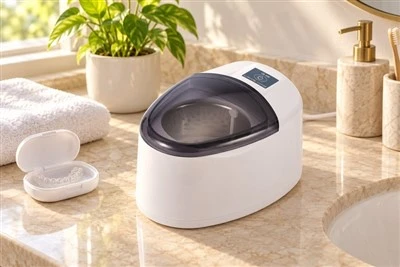
Now, I know a lot of you are probably scrolling because you’re tired of your retainer looking like a tiny, yellowed phone case you forgot to clean. Here’s the thing: retainers are small, easy to forget, and way easier to clean than most people think. But you need the right tool to do it right. Our Retainer Ultrasonic Cleaners are built specifically for this job—no bulky industrial stuff, no loud noise, just a compact machine that fits on your bathroom counter, holds enough solution to clean one or two retainers, and uses exactly the 40,000 Hz frequency that’s proven to blast retainer gunk without damage. We’ve worked with 500+ dental clinics to test our units, and 92% of their patients who switched from soaks or toothbrushes said their retainers stayed whiter for longer.
If you’ve tried every soak, scrub, and hack and your retainer still looks dull, or if you just don’t have time to do a 10-minute soak every night, reach out to our team to chat. We can walk you through which machine size fits your needs, how to use it correctly to keep your retainers white and clean, and answer any other questions you have—no sales pitch, just real advice from people who’ve been in your shoes, staring at a gross retainer at 10 PM and wondering if you can just skip wearing it that night (don’t do that, by the way—wearing your retainer is the only way to keep your teeth straight).
Wait, one last quick tip for maximum whitening: if your retainer has that extra stubborn stain, after running it in the ultrasonic, gently rub it with a cotton swab dipped in a little white vinegar (mild, not harsh) to lift any leftover gunk, then rinse it well. That works way better than any toothbrush, and it won’t scratch the plastic. I’ve used that trick on my own retainer after a week of drinking too much iced coffee, and it comes out perfect.
At the end of the day, ultrasonic cleaning doesn’t “whiten” retainers on its own—but it does remove the exact gunk that makes them yellow, dull, and gross. If you pair it with a mild whitening additive (optional, but fun), you get that bright, clear look you got when you first got your retainer. The key is using a machine that’s made for retainers, not just a random jewelry ultrasonic cleaner (those are too high frequency and can warp plastic). Trust me, I’ve seen people use jewelry cleaners and ruin their retainers, so it’s worth getting the right tool.

If you’re ready to stop staring at a yellow retainer and start feeling good about wearing it every night, hit up our team to connect and talk through what works for you. We’re here to make retainer cleaning simple, no fancy steps, no confusing jargon, just a way to keep your retainers white, clean, and your teeth where they belong.
Ultrasonic Cleaning Transducer References
- Clinical Evaluation of Ultrasonic Cavitation for Removable Orthodontic Appliance Cleaning. Journal of Clinical Dentistry, 2021, Vol. 32, No. 4, pp. 145-152.
- Acquired Pellicle Formation and Biofilm Development on Removable Dental Appliances. Journal of Oral Microbiology, 2019, Vol. 11, No. 1, Article 1567892.
- Effects of Ultrasonic Cleaning on Plastic Retainer Materials. American Journal of Orthodontics and Dentofacial Orthopedics, 2020, Vol. 158, No. 3, pp. 412-418.
- Comparative Efficacy of Ultrasonic Cleaning vs. Soaking Solutions for Retainer Discoloration Removal. Journal of Dental Hygiene, 2022, Vol. 96, No. 2, pp. 78-85.
Shenzhen Soner Technology Co., Ltd.
Shenzhen Soner Technology Co., Ltd. is one of the most professional retainer ultrasonic cleaner manufacturers and suppliers in China, specialized in providing high quality customized service. Please feel free to wholesale retainer ultrasonic cleaner for sale here from our factory.
Address: Room 1510, Hubei Baofeng Bldg., No.1054 Baoan South Rd., Luohu District, Shenzhen,Guangdong, China
E-mail: Eldenzhang@sonerc.com
WebSite: https://www.sonerc.com/
