When we supply combined terminal crimping machines to automotive manufacturers, electronics assemblers, and industrial wiring facilities, one question comes up in almost every introductory call: “What industry certifications do your machines need to meet?” This is not a trivial ask. A crimp that fails a certification standard can lead to product recalls, worker injuries, and costly downtime, so knowing the right certifications for combined terminal crimping equipment isn’t just a regulatory box to check—it’s the foundation of a machine that works reliably, safely, and compliantly in real production lines. Combined Terminal Crimping Machine

First, let’s break down what a combined terminal crimping machine does, because the certification requirements tie directly to its function. These machines don’t just crimp terminals onto wires; many also cut wires, strip insulation, tin conductors, and crimp on sleeves or seals in a single, automated cycle. That means they operate with high force, sharp cutting components, and in some cases, electrical wiring that interacts with sensitive electronics. Each of these functions brings its own set of industry standards, and skipping even one can leave a production line non-compliant.
The most universal certification for any industrial machine used in manufacturing is OSHA compliance, but wait—OSHA is a regulatory body, not a third-party certification, so manufacturers often rely on third-party testing to prove their machines meet OSHA’s safety standards. For crimping machines, OSHA’s General Duty Clause (29 CFR 1910) and specific standards for machine guarding (29 CFR 1910.212) apply. Our machines, for example, include interlocking safety doors that shut down the crimp head the second a user opens them, photoelectric sensors that stop operation if a hand or tool enters the work zone, and pinch point guards on all moving parts. To document that these features meet OSHA’s requirements, we pursue voluntary third-party certifications like ANSI B11.0, which is the American National Standard for safety of industrial machinery. ANSI B11.0 covers risk assessment, machine control systems, and safety barriers, and it’s widely recognized by OSHA as a way to demonstrate compliance with federal safety rules. Many of our North American clients won’t even consider a crimping machine without an ANSI B11.0 certification, because it eliminates the risk of OSHA fines and workman’s compensation claims if an accident occurs.
Next, for machines used in automotive manufacturing—one of the largest markets for combined terminal crimping equipment—there’s IATF 16949 certification. Wait, no, IATF 16949 is a quality management standard for automotive suppliers, but when it comes to specific equipment performance, automotive brands like Ford, GM, and Tesla require crimping machines to meet ISO 13082, the International Standard for crimping tools and machines for electrical wires. ISO 13082 sets test methods for crimp quality, cycle time accuracy, and machine durability. For example, the standard requires that a crimped terminal maintain a pull-out strength of at least 150 Newtons for 16 AWG wire, and that the machine’s crimp depth tolerance never deviates more than 0.02 mm over 10,000 cycles. Our combined terminal crimping machines undergo ISO 13082 testing in our in-house lab before every shipment, and we provide a test report to every automotive client to prove their machines meet this standard. What many people don’t realize is that automotive recalls from bad crimps aren’t just expensive—they damage brand reputation. So automotive clients treat ISO 13082 certification as non-negotiable, not just a recommendation.
For electronics manufacturing, another core market, the key certification is UL 1082, the Underwriters Laboratories standard for industrial control equipment. Combined terminal crimping machines often include programmable logic controllers (PLCs), touchscreen interfaces, and low-voltage components that pose electrical fire or shock risks. UL 1082 tests for insulation resistance, voltage breakdown, and proper grounding. For example, our machines have a 24V DC control circuit that’s fully isolated from the 220V or 480V power input, per UL 1082 requirements. In Asia, many electronics clients also require JIS C 60204-1, the Japanese Industrial Standard for electrical equipment of machines, which aligns with UL 1082 but has specific nuances for voltage ratings in Japanese manufacturing environments. A few years back, we had a client in Southeast Asia who almost rejected a shipment because our machine didn’t have JIS C 60204-1 certification—they said their local electrical safety inspector would not approve a machine without it, even if it was UL-listed. That taught me that regional certifications matter, not just global ones.
Then there’s a certification that’s specific to crimp quality itself: the IPC-WHMA-A-620, or the Association Connecting Electronics Industries (IPC) standard for wire harnesses. IPC-A-620 outlines the requirements for crimped connections, and many electronics manufacturers require their crimping machines to be validated to this standard. Unlike ISO 13082, which is about machine performance, IPC-A-620 is about the end product: the crimped wire and terminal. Our team works with clients to run crimp pull tests, cross-section analyses of crimps, and continuity tests to ensure that every crimp produced by our machines meets IPC-A-620’s requirements for both mechanical strength and electrical conductivity. For example, IPC-A-620 specifies that a good crimp should have no broken wire strands, no insulation encroachment into the conductor barrel, and a pull-out strength that exceeds 100% of the wire’s tensile strength. We include IPC-A-620 validation as a standard part of our pre-shipment testing for all electronics-focused machines, and some clients even require annual re-validation to ensure consistent performance.
Another often-overlooked certification is CE marking for machines sold in the European Economic Area (EEA). CE marking isn’t a standard—it’s a compliance mark that proves a machine meets EU directives, including the Machinery Directive (2006/42/EC) and the Low Voltage Directive (2014/35/EU). For combined terminal crimping machines sold in Germany, France, or Poland, CE marking is mandatory. To get CE marked, we have to conduct a full risk assessment of the machine, document all safety features, and test it against EN standards, which are the European versions of ANSI and ISO standards. For example, EN ISO 13082 is the European equivalent of the international crimping machine standard, and EN 60204-1 is the electrical safety standard for EU markets. We have a dedicated team that handles CE certification for our EEA-bound machines, and many of our European clients ask to see the full CE documentation before placing an order, because it’s a legal requirement for installation on their factory floor.
Wait, there’s also a certification for machines used in medical device manufacturing, which is a growing segment for us. Medical wiring harnesses, like those used in pacemakers or diagnostic equipment, require extremely high reliability, so clients demand ISO 13485 certification for both the machine and the manufacturing process. ISO 13485 is the quality management system standard for medical devices, and it requires that all equipment used to produce medical components meets strict traceability and performance standards. Our combined terminal crimping machines for medical applications are calibrated to within 0.01 mm of crimp depth, and every crimp cycle is logged and stored for traceability, per ISO 13485 requirements. We also provide clients with a full set of documentation, including calibration certificates and material traceability, that they need to meet FDA regulations for medical devices. That’s a big one—medical clients can’t risk a crimp failure that would lead to a product recall or, worse, a patient injury, so ISO 13485 compliance is non-negotiable for that market.
I’ve seen a lot of suppliers cut corners on these certifications, especially for lower-volume machines, but in my 12 years as a combined terminal crimping machine supplier, that almost always leads to problems down the line. A client in Mexico once bought a used crimping machine from a non-certified supplier, and they had to shut down their production line for three days because the machine’s crimps didn’t meet IPC-A-620, leading to 2,000 defective wire harnesses. They ended up reaching out to us, and we not only supplied a certified machine but also helped them rework the defective parts. That experience taught me that certifications aren’t just paperwork—they’re a guarantee that the machine will do what it’s supposed to do, when it’s supposed to do it.
Now, let’s talk about what certifications you might not need, depending on your application. If you’re a small business making low-volume wiring harnesses for a hobby or local project, you might not need all the industrial certifications. But if you’re scaling to high-volume production, or if your products go into automotive, electronics, or medical devices, those certifications are required by your clients and regulators. For example, a startup that sells custom wiring harnesses for drones might get away with a non-certified machine, but once they land a contract with a major drone manufacturer, that client will require ISO 13082 and IPC-A-620 certification before they even consider placing a PO.
Another thing to note: certifications aren’t one-and-done. Most of these standards require annual audits or re-testing to ensure that the machine’s performance doesn’t degrade over time. We offer post-purchase support, including calibration services and annual re-validation tests, to help our clients maintain their certifications. For example, we’ll send a technician to a client’s factory every 12 months to test the machine’s crimp accuracy, safety features, and electrical performance, and provide a new test report that they can use for regulatory inspections.
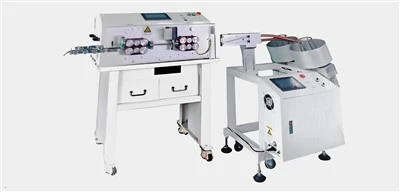
At the end of the day, the certifications for a combined terminal crimping machine boil down to three core goals: safety for workers, reliability for the end product, and compliance with regulatory requirements. If you’re in the market for a new combined terminal crimping machine, don’t just ask about price or cycle speed—ask about the certifications, and make sure they match your industry and regulatory needs. If you have questions about which certifications are right for your specific application, feel free to reach out to our team to discuss your requirements and find the right machine for your production line.
Automatic Marker Tube Threading Machine References:
ANSI B11.0-2020, Safety of Machinery, American National Standards Institute
ISO 13082:2017, Crimping Tools and Machines for Electrical Wires – Test Methods, International Organization for Standardization
IPC-WHMA-A-620E, Requirements and Acceptance for Cable and Wire Harness Assemblies, Association Connecting Electronics Industries
UL 1082, Standard for Safety for Industrial Control Equipment, Underwriters Laboratories
Machinery Directive 2006/42/EC, European Union
ISO 13485:2016, Medical Devices – Quality Management Systems – Requirements for Regulatory Purposes, International Organization for Standardization
Suzhou Keweisi Electronic Technology Co., Ltd.
We are one of the most professional combined terminal crimping machine manufacturers and suppliers in China. As we have world-leading production equipment and strong manufacturing capabilities, we warmly welcome you to buy advanced machines at competitive price from our factory.
Address: Yunchuang road No.221, block C, Haibo tech park,Suzhou, P.R China.
E-mail: wenwei200982@126.com
WebSite: https://www.szkowas.com/
